
Using lived experience to reform mental health
In conversation with:
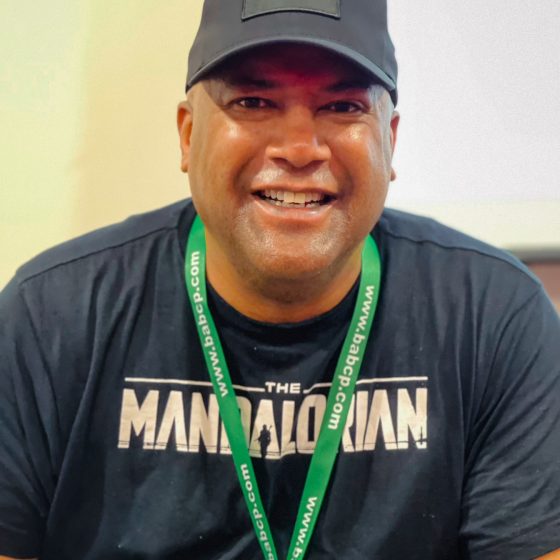
Chris Frederick, Mental Health Advisor
There are often wide gaps between the research community, decision-makers and people with lived experience. Chris uses his storytelling and advocacy skills to shape the narrative of Black men facing mental health challenges.
How has your background helped?
I spent 30 years working in the commercial sector – recruitment, outsourcing sales, business development, and marketing complex solutions. I lived in Asia for nearly 20 years and travelled extensively but I returned to the UK in 2018 after my first suicide attempt. Three years later, I had another attempt.
I needed purpose – something to get me out of bed in the morning. I knew there had to be something I could do. What started as a personal project – interviewing people about the mental health sector – grew into something much bigger: Project Soul Stride.
By November 2024, I’d interviewed 185 people, mainly in the UK. Over time, it became less of a project and more of a calling.
How much of your work involves communications?
Today, Project Soul Stride is my primary focus. It allows me to engage with policymakers and senior leaders to help them understand the realities of lived experience. I always remind them that I have been through this – and I want to help other Black men navigate the mental health system.
Importantly, it has opened lots of doors to support other organisations and take part in other lived experience projects.
Last year, I was featured in The Voice Newspaper and appeared in a film for Mind called Finding my way back from depression.
Just last month, I was invited to share my experiences with MPs at the House of Commons. Those insights will contribute to this year’s inquiry into the state of community mental health services for adults with severe mental illnesses – and we’ll be quoted in the final report.
At my lowest point, I could never have imagined using my skills and passion to help drive change in this way.
What’s the most important principle for you when developing content?
Clear communication. I rapidly digest content using AI and translate complex research into accessible insights through blogs and storytelling.
I serve as a conduit between two worlds – the lived experience of a Black man facing mental health challenges and the decision-makers with the power to improve services. This helps bridge the gap between academic theory and real people with mental health challenges.
Many of them will never access research papers or speak directly with researchers, so there’s a huge chasm where information gets lost, leaving people struggling to find the support they need.
What are the biggest misconceptions you see in your work??
That addressing inequality is about creating division rather than fostering inclusion.
I focus on solution-driven conversations rather than conflict. The disparities in mental health treatment between Black and White patients are undeniable. But I try to steer away from weaponising the discussion. Instead, I bring people together to share ideas and find solutions.
Of course, we must acknowledge that systemic racism is part of the wider context, but it’s not where I lead the conversation. The reality is that generational trauma, toxic masculinity, a reluctance to seek help and economic struggles all disproportionately affect Black men. And these challenges must be addressed with cultural competence.
How do you approach health communication?
I research extensively. I maintain a library of over 500 white papers on suicidality and mental health worldwide. Since I can’t read them all in detail, I use AI to distil key insights and make them actionable.
I’m a visual thinker, so I use mind maps to prioritise my ideas and transform them into blogs, articles, and speeches. Over time, I have developed key phrases – like ‘research to influence’ and ‘fostering collective action’ – to articulate complex messages in a way that resonates.
I try to write consistently and carefully consider my tone. I try to be authentic, which seems to appeal to everyone – from academics to MPs.
Talking about suicide was a difficult decision. After my first attempt, I disappeared from life. Friends and colleagues were asking, ‘What happened to Chris?’
One friend encouraged me to write a blog about my experience to update people. I took his advice, and the response was extraordinary.
So many people reached out, saying they appreciated my honesty. Soon, men in my network started sharing their own stories. That gave me the confidence to share my story more widely.
What’s on the horizon for you?
If you’d asked me a year ago whether I could imagine speaking truth to power in the House of Commons, I would have laughed. But 2024 was extraordinary, and 2025 is already following the same trajectory.
At the same time, I live, sleep and work in one room in a shared house. I continue to struggle with chronic loneliness, social isolation, anxiety, depression and suicidal thoughts. Like many, I can’t access the services I need and can’t afford private care.
It’s this dual reality – being recognised for my advocacy while still navigating barriers to care – that drives my commitment to change.
I have a platform and an opportunity to be a role model for other Black men who want to speak up and out about their mental health journeys. One of my goals is to mentor young Black men to become the next generation of mental health advocates.
I don’t know exactly where this path will lead, but speaking in Parliament is all the proof I need that I need to keep going.
Three tips from Chris:
1. Be authentic. Don’t be afraid to share your personal story – it can add real value.
2. Simplify your process. Use technology and visual tools to break down complex information.
3. Adopt an ‘insight to influence’ approach. Always think about how you can use any information to create positive change.